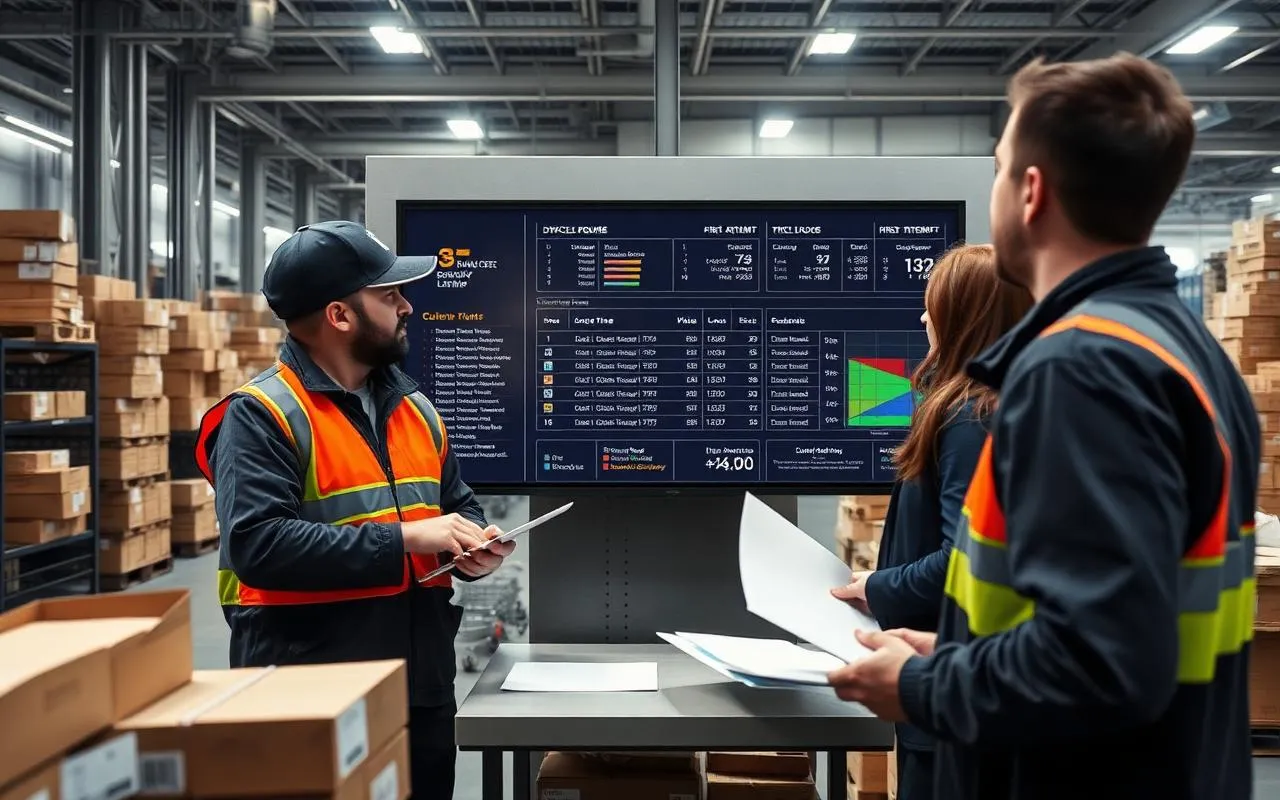


Walk into the transportation control tower of any mid-sized shipper at 2 p.m. and you'll see the same scene. Two dispatchers are working the phones with a carrier whose driver is now four hours late on a backhaul. The OTIF dashboard for the largest retail customer is sitting at 91 percent against a contractual minimum of 96, which means the next chargeback statement is going to land at $340,000 for the quarter. The dock board shows nine inbound trailers sitting on the yard for an average of 3.5 hours waiting for a door. The TMS is auto-tendering loads at rates 12 percent above last quarter because the spot market is running hot. The transportation manager is in a meeting trying to explain to the CFO why the cost-per-unit-shipped just went up 9 percent year-over-year. Nobody is doing anything wrong. The system is just — exposed.
Transportation operations are one of the most strategically important and operationally underserved areas in any supply chain. The reason is simple: transportation is the last touchpoint with the customer, the second-largest cost line in most consumer-goods supply chains, and a process with severe variability driven by carrier capacity, weather, traffic, and dock readiness. Get it right and you simultaneously lift OTIF by 5 to 8 percentage points, cut transportation cost per unit by 8 to 14 percent, reduce dock dwell time by 30 to 50 percent, and protect margin against the carrier rate volatility that's been the dominant story in U.S. freight markets for the last six years. The published case studies from the Council of Supply Chain Management Professionals consistently document these results across hundreds of structured improvement programs.
This article is the playbook. We'll walk through what transportation underperformance really costs, how to size the prize before you commit a project team, the structured DMAIC approach that delivers durable gains (and why TMS investments alone rarely do), the carrier-relationship dynamics that decide whether the gain holds, and the mistakes that quietly destroy the math after the project closes. By the end you'll have a clear view of what a credible transportation initiative looks like — and a way to estimate the dollars before you commit a budget.
Why on-time delivery is the highest-stakes metric in modern supply chain
Most shippers track three numbers: on-time in-full (OTIF) to customers, transportation cost per unit shipped or per case, and dock dwell time for inbound and outbound. The benchmarks vary by mode and customer mix, but the patterns are consistent. Top-quartile retail shippers run OTIF above 96 percent against major retail customers; the median runs 88 to 92. Top-quartile cost per case for outbound truckload runs 12 to 18 percent of cost of goods sold; the median runs 16 to 24. Top-quartile dock dwell time on outbound runs under 60 minutes door-in to door-out; the median runs 90 to 150. Each percentage point of OTIF, each percent of cost-per-case, and each minute of dwell translates directly into recoverable margin.
Here's the math. A consumer-goods shipper moving 240,000 outbound truckloads per year at an average linehaul of $2,400, with an OTIF rate of 89 percent against a major retail customer that charges 3 percent of invoice for OTIF misses, is exposed to roughly $14 million per year in chargebacks before adjustments. Cutting the OTIF gap from 11 percent to 4 percent (lifting OTIF to 96 percent — an achievable target for a structured program) recovers roughly $9 million in chargeback exposure annually. Add the cost-per-case reduction (typically 8 to 12 percent on a well-run program, worth $40 to $70 million on a $500M annual freight spend), and the dock dwell time recovery (worth 6 to 10 percent of fleet productivity), and the total annualized impact lands in the $15 to $35 million range on a mid-sized shipper. That's the kind of number that gets a board's attention.
The cost recovery is only half the story. The bigger strategic effect comes from what reliable transportation does for the customer relationship. A shipper that consistently hits OTIF above 96 percent is a shipper whose retail customer awards the next category review with confidence. A shipper at 88 percent is a shipper whose category review goes to a competitor. The downstream effect of a transportation Lean Six Sigma project isn't just chargeback recovery — it's the customer share of shelf, the contract renewals, and the new-product launch slots that depend on operational credibility. We've seen consumer-goods companies recover one to three percentage points of shelf-share at a major retail customer purely as a downstream effect of OTIF improvement.
The methodology: DMAIC for transportation
DMAIC for transportation has a structural twist that distinguishes it from most other domains: the process spans three different organizations — the shipper, the carrier, and the receiver — and the project has to engage all three to produce sustained results. Shippers that try to lift OTIF unilaterally produce a slide deck. Shippers that engage their top three carriers and their top three customers in the redesign produce 5 to 8 percentage points of OTIF lift in 180 days. The methodology has to be designed around that cross-organization reality from week one.
Define: scope by lane and by customer
Pick your top three to five lanes by volume and your top three customers by chargeback exposure. Define the scope as 'OTIF, cost per case, and dwell time on these lanes to these customers.' Don't try to fix all of transportation at once. The methodology, the standard work, and the carrier engagement model all replicate cleanly to additional lanes after the first wave delivers.
The Define charter names the lanes, the customers, the baseline (OTIF percentage with the variance, plus cost per case and dwell time), the target (typically 5 to 8 points of OTIF lift, 8 to 14 percent cost reduction, 30 to 50 percent dwell reduction), the dollar value, the timeline (150 to 210 days for a transportation Green Belt project — slightly longer because of the carrier engagement cycles), and the sponsor (typically the VP of supply chain or the chief operating officer).
Measure: walk the value stream from order to proof of delivery
Walk 50 to 100 shipments end-to-end. Timestamp every handoff: order received to load planned, load planned to tendered to carrier, tendered to accepted, accepted to dock appointment, appointment to driver arrival, arrival to door assigned, door assigned to load complete, complete to driver departure, departure to in-transit milestones, milestones to delivery, delivery to proof of delivery. Pull six months of TMS, ELD, and dock data on each step. Validate with the dispatchers, the dock supervisors, and at least two carrier dispatchers from each major partner.
Most shippers discover that the OTIF problem is concentrated in three specific failure modes: (1) tendering delays where loads are tendered too late for the carrier to honor the appointment, (2) dock readiness failures where the load isn't built when the driver arrives, and (3) appointment compliance failures at the receiving dock. The cost-per-case problem usually traces to lane density (too many low-volume lanes that should be consolidated), spot-market dependency (loads that should have been on contract pricing falling to the spot market because of late tendering), and accessorial leakage (detention, layover, and reconsignment fees that aren't being managed). Each of these has a different intervention.
Analyze: separate carrier issues from shipper issues from receiver issues
Pareto the OTIF misses by root cause. Classify each miss as shipper-controllable (tendering delay, load not ready, paperwork error), carrier-controllable (driver late, equipment failure, mis-routing), or receiver-controllable (appointment delay, dock unavailable, refusal at receipt). Most shippers discover that 50 to 65 percent of OTIF misses are shipper-controllable — and that the team has been quietly blaming carriers for years on misses they actually caused. Honest classification is uncomfortable and necessary. It's also where the largest single bucket of recoverable performance lives.
Improve: tender earlier, build better, dwell shorter
The Improve phase has three reliable patterns. First: tender earlier. Most shippers tender loads 6 to 18 hours before pickup. Top-quartile shippers tender 24 to 48 hours ahead, which gives the carrier the planning window to honor the appointment and avoid the spot market. The intervention is a load planning cadence change, not a TMS configuration. Second: redesign the load build process so the load is physically ready 60 minutes before the driver appointment, not 60 minutes after. This usually requires changes to the warehouse pick wave timing and the staging discipline. Third: redesign the receiving-dock appointment process with the customer — most major retail customers will work with shippers on appointment scheduling, drop-trailer programs, and FastPark options if the shipper engages constructively. The receiver-side improvement alone typically recovers 25 to 40 percent of the OTIF gap.
Control: hold the gain across carriers, lanes, and seasons
Control plans for transportation are uniquely cross-organizational. The shipper-side plan names the daily metrics (OTIF by lane and customer, tender lead time, dock dwell time, accessorial spend), the owner (transportation manager and dock manager), and the cadence (daily 15-minute control tower huddle). The carrier-side plan is a quarterly performance scorecard reviewed jointly with the top five to ten carriers, with named action items and a documented escalation. The customer-side plan is a quarterly OTIF business review with each top customer that surfaces issues before they become chargebacks. Without all three layers, the gain decays.
What a real transportation project looks like, week by week
Weeks 1–4: Define and charter
VP of supply chain sponsors. Project leader is typically the head of transportation. Team includes a load planner, a dispatcher, a dock supervisor, a TMS administrator, a customer-facing supply chain partner from the top retail account, two carrier reps from the top contract carriers, and a finance partner.
Weeks 5–10: Measure
Walk 50–100 shipments end-to-end. Pull six months of TMS, ELD, and dock data. Build the value stream map. Lock the baseline by lane and customer.
Weeks 11–14: Analyze
Pareto the OTIF misses by controllability. Identify the top three to five interventions per category. Validate against data. Sign the Analyze tollgate.
Weeks 15–22: Improve
Run three Kaizen sessions: tender lead time, dock readiness, and customer-side appointment redesign. Pilot interventions on the top two lanes for four to six weeks. Engage carriers in joint scorecards. Engage customers in joint OTIF reviews.
Weeks 23–30: Control
Run the new operation across all in-scope lanes for eight weeks. Hold the daily control tower huddle, the monthly carrier scorecard, and the quarterly customer OTIF review. Validate financial impact with finance. Hand off with named accountability.
The mistakes that destroy the math
Mistake 1: Blaming the carrier without classifying the miss
Most shippers privately attribute OTIF misses to carrier performance. The data, when honestly classified, almost always shows 50–65 percent are shipper-controllable. Until the team confronts the classification, no improvement is possible.
Mistake 2: Treating transportation as a TMS configuration problem
A new TMS deployed onto an undisciplined tender process produces a faster way to be late. Redesign the operational discipline first; the TMS investment delivers 2x the ROI of the original business case.
Mistake 3: Excluding carriers from the redesign
Carriers know exactly where the dock readiness fails are. They've been telling shippers for years and the feedback hasn't been operationalized. Engage your top five carriers in joint quarterly scorecards from week one of the project.
Mistake 4: Ignoring the customer side
Receiver-side appointment delays are the single largest avoidable contributor to OTIF misses against major retail customers. Most retailers will engage constructively if the conversation is data-driven and operational. Skip the customer-side conversation and the project leaves 25–40 percent of available gain on the table.
Mistake 5: Counting only the chargeback recovery
Chargeback recovery is the visible number. Cost-per-case, dwell time, and shelf-share are usually larger combined. Build the full ROI model in the Define phase and validate all four with finance.
How to size the prize for your transportation operation
Pull your last 12 months of OTIF by customer, your annual freight spend, your accessorial spend, your average dwell time, and your retail chargeback exposure. Calculate the chargeback recovery (50 percent of current chargeback dollars). Add the cost-per-case opportunity (8–12 percent of freight spend). Add the accessorial reduction (30–50 percent of current accessorials). Discount by 50 percent for realism. If the discounted number is more than $4 million, you have a project worth chartering. Most consumer-goods shippers above $200 million in freight spend are sitting on $15 to $40 million of opportunity.
If you'd like to walk through the math on your specific transportation operation — confidentially, with a Master Black Belt who has run these projects with consumer-goods shippers, retailers, and 3PL partners — book a free 30-minute consultation. We'll size the prize and tell you honestly whether a Lean Six Sigma project is the right next move.