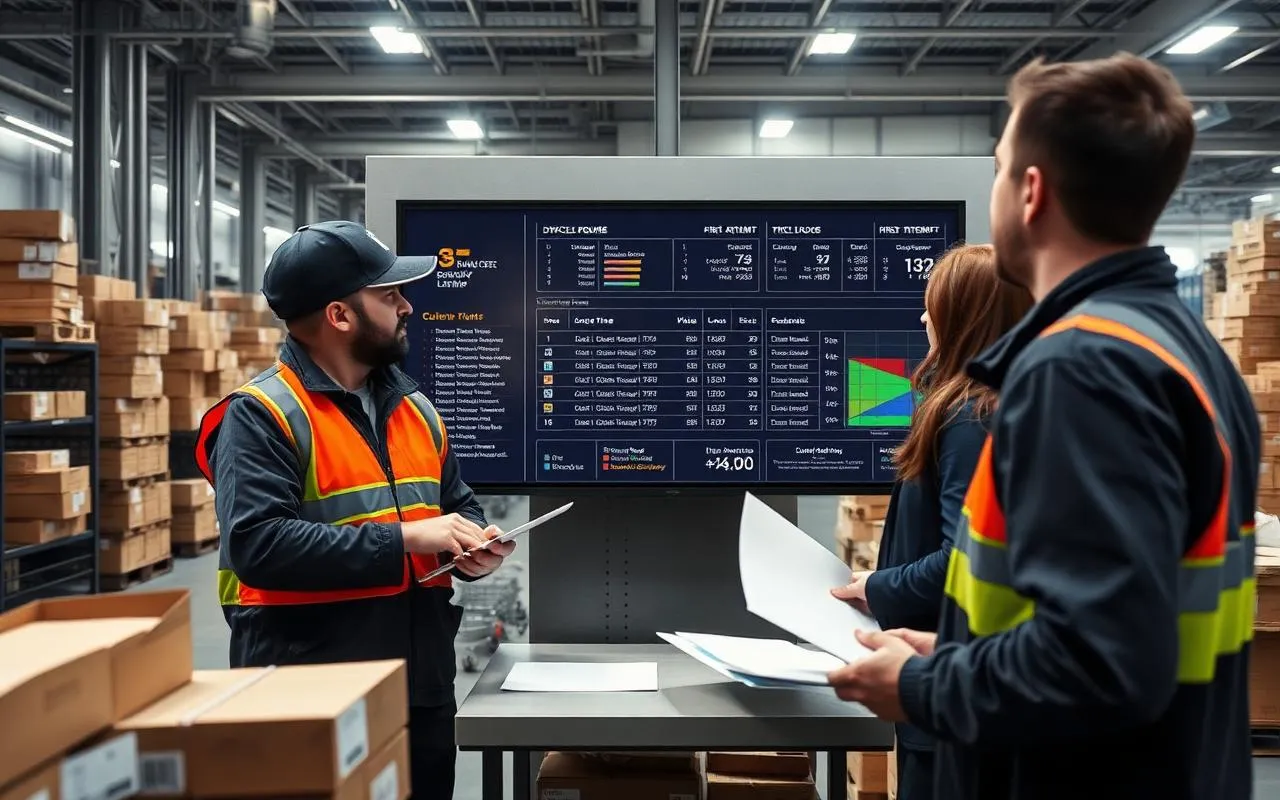


Walk into any mid-sized distribution center on the second shift of a peak Tuesday and you'll see the same operational picture in city after city. Pickers are walking. A lot. The labor management dashboard says the average pick rate is 124 lines per hour against an engineered standard of 165. The replenishment team is two hours behind, so the forward pick locations on the fastest-moving SKUs are stocked-out, sending pickers to bulk reserve to do five-minute retrievals on what should have been twelve-second pulls. The pack stations have a 19-minute queue of totes waiting. Two pickers are standing at a single-line printer waiting for labels. The assistant operations manager is on the radio coordinating a recount on a customer escalation that traces back to a mis-pick from this morning. Nobody is doing anything wrong. The system is just — leaking.
Warehouse and distribution operations are one of the highest-leverage places in any supply chain to apply Lean Six Sigma. The methodology works because a DC is a queueing system with discrete handoffs, measurable cycle times, hard variability, and a labor cost line that scales linearly with throughput. Get it right and you simultaneously lift pick rates by 25 to 40 percent, cut order cycle time by 30 to 40 percent, drive mis-pick rates from 0.3 to under 0.05 percent, and shrink overtime spend by 50 to 70 percent — without expanding the building, without buying new automation, and without touching the WMS. The published case studies from organizations like the Warehousing Education and Research Council and MHI consistently document these results across hundreds of DC improvement programs.
This article is the playbook. We'll walk through what warehouse productivity loss really costs, how to size the prize before you commit a project team, the structured DMAIC approach that delivers durable productivity (and why labor management system tweaks alone rarely do), the human factors that decide whether the gain holds, and the mistakes that quietly destroy the math after the consultants leave. By the end you'll have a clear view of what a credible DC productivity initiative looks like in your network — and a way to estimate the dollars before you commit a budget.
Why pick-pack productivity is the most undervalued metric in distribution
Most DC operators track three numbers: lines per labor hour (LPH) for picking, cases per labor hour for packing and outbound, and order cycle time from cut-off to ready-to-ship. The benchmarks are well-published. Top-quartile broken-case picking in apparel and consumer goods runs 180 to 240 LPH; the industry median sits at 110 to 140. Top-quartile case picking runs 95 to 140 cases per hour; the median runs 60 to 90. Top-quartile next-day order cycle time runs 4 to 6 hours from cut-off to dock; the median runs 8 to 14. The gap between top-quartile and median is roughly the ROI of a structured Lean Six Sigma program.
Here's the math. A 250,000-square-foot DC running 1.4 million lines per month at an average pick rate of 124 LPH, with a fully-loaded labor cost of $32 per hour, is spending $361,000 per month on direct picking labor — roughly $4.3 million annualized for picking alone. Lifting the pick rate from 124 to 170 (a 37 percent gain that's well within the published range for a structured project) cuts the labor hours required by 27 percent. That's a $1.16 million annualized direct labor reduction on picking. Add the analogous gains in packing, replenishment, and outbound; add the overtime collapse that comes with productivity stability; add the order-cycle-time reduction that lets the DC handle 15 to 25 percent more volume without adding shifts. The total annualized impact on a single facility lands in the $3 to $7 million range. That's not a hypothetical. That's the kind of number we put in front of a CFO before a project starts.
The labor recovery is only half the story. The bigger strategic effect comes from what stable productivity does for the rest of the network. A DC that consistently hits its pick standard and its cycle-time SLA stops generating the customer escalations that pull the operations team into firefighting. The on-time-in-full rate to customers rises by 4 to 8 percentage points. The chargebacks from retail customers (the ones that quietly run 1.5 to 3 percent of revenue in apparel and consumer goods) drop by half. We've watched companies recover the equivalent of 2 to 4 percent of net revenue from retail chargeback reduction alone — purely as a downstream effect of DC redesign — without renegotiating a single customer contract.
The methodology: DMAIC for the distribution center
DMAIC works in DC operations the same way it works in manufacturing — same five phases, same tollgate discipline, same project structure. The difference is that DC variability is dominated by inbound demand spikes, SKU velocity churn, and labor turnover, none of which are present in a typical manufacturing line. The methodology has to account for that. Projects that try to lift productivity without first stabilizing replenishment and slotting produce a fast initial gain that decays inside two SKU cycles. Projects that combine slotting, replenishment, and pick-process redesign in a sequenced DMAIC structure produce 25 to 40 percent gains that hold across seasonal peaks.
Define: scope the area that matters
The first mistake most DCs make is trying to fix productivity across all areas simultaneously. Don't. Pick the area where the labor spend is largest and the variation against standard is widest — almost always broken-case piece picking in fast-moving SKUs for apparel and consumer goods, or full-case picking in fast-moving zones for grocery and hardlines. Define the scope as 'pick rate and order cycle time for [zone] across all shifts.' Trying to fix everything at once produces nothing the control plan can hold.
The Define charter names the zone, the SKU velocity tier, the baseline (lines per hour with the variance, plus the order cycle time and mis-pick rate), the target (typically a 25 to 40 percent LPH lift with corresponding cycle-time and accuracy improvement), the dollar value (calculated against direct labor and overtime), the timeline (120 to 180 days for a Green Belt DC project), and the sponsor (typically the VP of operations or the DC general manager). If you can't fill in those six fields cleanly, you're not ready for the Measure phase.
Measure: time-stamp the picker's day
This is the step most DCs skip. The labor management system tells you LPH and total time on task. It does not tell you what the picker is actually doing during the unproductive minutes. To genuinely understand the productivity gap, you have to spend two to three full shifts on the floor with a stopwatch, shadowing pickers across all velocity zones, and timestamping every activity: pick time, travel time, search time, replenishment wait time, system wait time, recount time, label printer wait time, supervisor consultation time, and break time. Build the timestamped category breakdown across 30 to 50 picker-hours of observation.
Most DCs discover that pure pick time accounts for only 35 to 45 percent of the picker's day. Travel time accounts for 25 to 35 percent. Search time (looking for an item that isn't where the WMS says it is) accounts for 6 to 12 percent. Wait time for replenishment, labels, totes, equipment, and supervisors accounts for another 10 to 15 percent. The remaining time is documented breaks. The productivity gap isn't in the pick — it's in the travel, the search, and the wait. That's where the methodology focuses.
Analyze: Pareto the non-pick time
Once you have the timestamped activity breakdown, the analysis is mechanical. Pareto the non-pick time. The top three contributors in most DCs are: (1) travel time driven by suboptimal slotting (fast movers stored in slow locations), (2) search time driven by inventory accuracy issues at the bin level, and (3) replenishment wait time driven by reactive rather than proactive replenishment of forward pick locations. Each has a different intervention. Treating them as a single 'pickers need to walk faster' problem is what produces the failed productivity campaigns DC operators have run for thirty years.
Improve: slot, replenish, then redesign the pick
The Improve phase has a sequence that matters. First, run a velocity-based slotting refresh that puts the top 20 percent of SKUs in the golden zone (waist-to-shoulder height, closest to the pack stations). Most DCs that have not run a slotting refresh in 18 months are sitting on a 12 to 18 percent travel reduction with no other change. Second, redesign replenishment from reactive to proactive: a structured min-max trigger by SKU velocity, with a dedicated replenishment shift two hours ahead of pick demand. The forward locations stay stocked, and search time collapses. Third, redesign the pick process itself with batch and zone picking in the highest-volume zones, voice or RF-directed picking with optimized travel paths, and visual management at each pick station that makes the standard work obvious.
Run all three in sequence inside a 90-day implementation window. The first two interventions produce roughly 15 to 22 percent of the LPH gain on their own. The third produces another 10 to 18 percent on top. Together they routinely deliver the 30 to 40 percent productivity lift that the Define phase committed to.
Control: hold the gain across shifts and through peak
DC control plans are uniquely demanding because the operation runs three shifts and most DCs do double or triple their average daily volume during peak season. The control plan names the daily metrics (LPH by zone by shift, order cycle time by wave, mis-pick rate, replenishment SLA), the owner per shift (the area supervisor and the shift manager), the cadence (a 10-minute shift-start huddle reviewing yesterday's metrics and today's plan, plus a daily area walk by the operations manager), and the escalation (what happens when the metric drifts for two shifts). Without that, the gain decays inside one peak. With it, the gain compounds — most DCs that hold their first project see the second project deliver 20 to 30 percent additional gain because the operating muscle is built.
What a real DC project looks like, week by week
Weeks 1–3: Define and charter
VP of operations or DC GM sponsors. Project leader is typically the operations manager or a continuous improvement director. Team includes pickers from each shift, a slotting analyst, a replenishment lead, a WMS administrator, a packout lead, and a finance partner.
Weeks 4–8: Measure
Shadow 30–50 picker-hours across shifts and zones. Timestamp every activity category. Pull 12 months of LPH, cycle time, accuracy, and overtime data. Build the activity Pareto. Lock the baseline.
Weeks 9–12: Analyze
Pareto the non-pick time. Identify the slotting opportunity, the replenishment opportunity, and the pick-process opportunity. Validate against data. Sign the Analyze tollgate.
Weeks 13–18: Improve
Run the slotting refresh first. Run the replenishment redesign second. Run the pick-process Kaizen third. Pilot each intervention in one zone for two to four weeks. Measure daily. Refine. Roll across the facility.
Weeks 19–24: Control
Run the new operation across all zones for six weeks. Hold the shift huddles. Validate financial impact with finance. Write the control plan. Hand off with named accountability per shift. Plan the rollout to the next zone or facility.
The mistakes that destroy the math
Mistake 1: Trying to fix LPH by tightening the standard
Engineered standard tweaks produce a one-time bump and a quiet revolt from the picker workforce. The productivity gain is in the system around the picker, not the picker's individual effort. Fix the system, the LPH follows.
Mistake 2: Skipping the slotting refresh
The single highest-leverage intervention in a DC productivity project is a velocity-based slotting refresh. DCs that try to redesign the pick process without first refreshing slotting deliver half the available gain.
Mistake 3: Letting WMS configuration constrain the redesign
Most DCs treat the WMS as fixed. It isn't. Slotting parameters, wave logic, replenishment triggers, and pick path optimization are all configurable. The project team has to include a WMS administrator from week one — and the configuration changes have to be in scope.
Mistake 4: Closing the project before peak
The real test of a DC productivity project is whether the gain holds at 2x daily volume. Hold the project open through one full peak season. Hand off only after the new process has held through the heaviest two-week stretch of the year.
Mistake 5: Counting only the labor savings
The labor number is the headline. The chargeback reduction, the OTIF lift, and the capacity recovery are usually larger combined. Build the full ROI model in the Define phase and validate all four with finance.
How to size the prize for your DC network
Pull your last 12 months of LPH by facility and zone, your direct labor cost, your overtime spend, your retail chargeback rate, and your OTIF rate. Calculate the labor opportunity (current LPH lift to top-quartile × annual hours × loaded labor rate). Add the overtime collapse opportunity (50 percent of current overtime spend). Add the chargeback recovery (50 percent of current chargeback dollars). Discount by 50 percent for realism. If the discounted number is more than $2 million on one facility, you have a project worth chartering. Most DC networks operating five or more facilities are sitting on $15 to $50 million of opportunity.
If you'd like to walk through the math on your specific network — confidentially, with a Master Black Belt who has run these projects in 3PL operations, retail DCs, and manufacturer-owned distribution — book a free 30-minute consultation. We'll size the prize and tell you honestly whether a Lean Six Sigma project is the right next move.