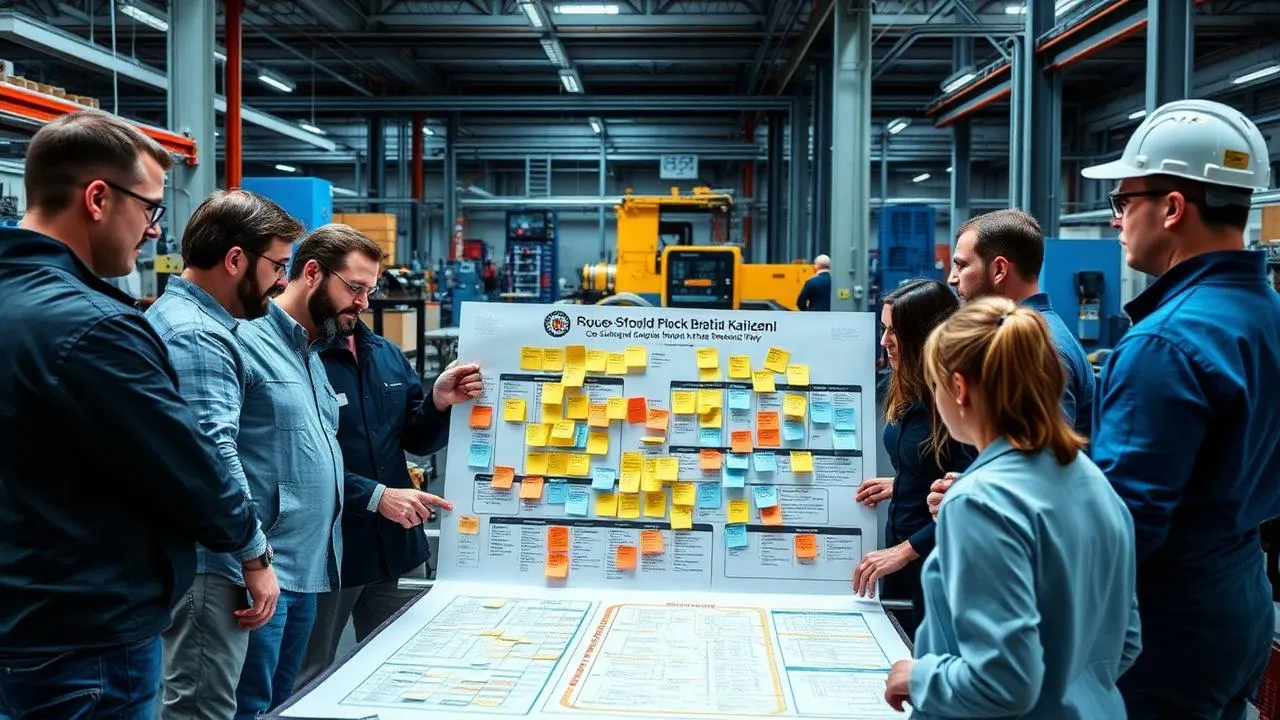


Walk any manufacturing floor in the United States this morning and you'll find the same quiet problem buried under the noise of running production: the line is down, again, for a changeover that's taking longer than it should. The operators aren't slacking. The schedule isn't unreasonable. The equipment isn't broken. It's just — slow. Forty-five minutes here. Ninety minutes there. A four-hour changeover on a die that everyone agrees "used to be faster." Multiply that across a year and you're looking at hundreds of thousands of dollars in lost capacity, plus a planning team that's been quietly trained to schedule longer runs of the same SKU just to avoid the pain.
This is the single biggest hidden constraint in most discrete manufacturing operations, and it is also one of the highest-leverage places to apply Lean Six Sigma. The methodology that addresses it — SMED, or Single Minute Exchange of Die, developed by Shigeo Shingo at Toyota in the 1950s — is now more than fifty years old and still routinely cuts changeover time by 50 to 80 percent in plants that haven't worked it deliberately. That's not a marketing number. That's the published, repeatable result from thousands of documented projects across industries from automotive stamping to plastics injection molding to consumer packaged goods.
This article is the playbook. We'll walk through what changeover time really costs in a manufacturing operation, how to size the prize before you commit a project team, the structured Lean Six Sigma approach that actually delivers the reduction (and why ad-hoc "let's just speed it up" rarely does), the human factors that decide whether the gain sticks, and the mistakes that quietly destroy the math after the consultants leave. By the end you'll have a clear view of what a credible changeover-reduction effort looks like in your plant — and a way to estimate the dollars before you commit a budget.
Why changeover time is the most undervalued metric in manufacturing
Most plant leaders track Overall Equipment Effectiveness (OEE) — the composite of availability, performance, and quality. World-class OEE in discrete manufacturing is generally cited as 85 percent. The reality is sobering: industry benchmarking from organizations like the Manufacturing Enterprise Solutions Association consistently puts the average across U.S. plants between 60 and 70 percent. The gap between average and world-class is roughly 15 to 25 percentage points — and the single largest contributor to that gap, in most discrete operations, is availability loss. The single largest contributor to availability loss is unplanned downtime and changeover.
Here's the math that should keep operations leaders up at night. A plant running a single bottleneck line at $4,000 per hour of throughput value, with eight changeovers per week averaging 2.5 hours each, is losing 20 hours of capacity per week. At 50 weeks per year, that's 1,000 hours of throughput, or roughly $4 million of annualized capacity locked up in changeover. Cutting that changeover time in half — a routine outcome of a structured SMED project — recovers $2 million of capacity per year, on the same equipment, with the same headcount, on the same shift pattern. That's not a hypothetical. That's the kind of number we put in front of a CFO before a project starts, and it's the kind of number finance signs off on after the project closes.
The capacity recovery is only half the story. The bigger strategic shift comes from what shorter changeovers let you do. When a changeover takes four hours, the planning team batches up runs of the same SKU to amortize the changeover time across more units. That means more inventory, more working capital tied up in finished goods, longer lead times to customers, and a quieter inability to respond to demand variation. When the same changeover takes 45 minutes, smaller batch sizes become economical. Inventory drops. Lead time shrinks. The plant gets agile. We've watched plants free up $3 to $8 million in working capital purely as a downstream effect of cutting changeover time and right-sizing batches — without touching the production schedule, the supplier base, or the warehouse.
The methodology: SMED inside a DMAIC frame
SMED is the technical core of changeover reduction. DMAIC — Define, Measure, Analyze, Improve, Control — is the project frame that makes the gain stick. Plants that try SMED without DMAIC tend to get a fast first result that decays over six months. Plants that try DMAIC without SMED tend to study the problem to death without producing a measurable change. The combination is what Lean Six Sigma actually delivers, and it's what a Green Belt or Black Belt project leader is trained to run.
Define: scope the changeover that matters
The first mistake most plants make is trying to fix every changeover at once. Don't. Pick one. Pick the changeover on the bottleneck line, on the highest-volume product family, with the longest current cycle time and the most frequent occurrence. That's where the dollars live. A focused project on one changeover type — typically a model changeover on a single line — produces a documented reduction, a control plan, and a replicable method that the team then rolls out to adjacent changeovers. Trying to fix everything at once produces nothing that the control plan can hold.
The Define phase ends with a project charter that names the line, the changeover, the baseline (in minutes from last good piece to first good piece, with the variance), the target (typically a 50 to 70 percent reduction), the dollar value (calculated against the bottleneck rate), the timeline (90 to 120 days for a Green Belt project), and the sponsor (typically the plant manager or the operations director). If you can't fill in those six fields cleanly, you're not ready for the Measure phase yet.
Measure: video the changeover and timestamp every step
This is the step most plants skip and most consulting engagements get wrong. To genuinely understand a changeover, you have to record at least three to five real changeovers — different operators, different shifts, different days — on video, and then build a timestamped step list from the recordings. Not a memory-based step list. Not the documented work instruction. The actual sequence, with elapsed time, recorded from real changeovers. The differences between the documented procedure and the real one are where the gains hide.
On a typical 2-hour changeover, the timestamped step list will run to 80 to 120 discrete steps. Each step gets categorized into one of three buckets, in classic Shingo terminology: Internal (must happen with the equipment stopped), External (can happen with the equipment running), or Wasted (no value either way — searching, walking, waiting, fetching, talking). On a first-pass video analysis of an unimproved changeover, it's normal to find 30 to 50 percent of elapsed time in the Wasted category, another 20 to 40 percent in steps that are currently classified as Internal but could be moved to External with simple staging changes, and only 20 to 40 percent in genuinely Internal steps that have to happen with the equipment stopped.
That distribution is the entire prize. Eliminate the Wasted time and you've recovered 30 to 50 percent of the changeover. Convert the misclassified Internal steps to External and you've recovered another 20 to 40 percent. The math works out to a 50 to 70 percent reduction before you've touched a single piece of physical equipment. Plants that come into a SMED project assuming they need to buy faster tooling are usually surprised that the first wave of gains is almost entirely procedural.
Analyze: find the real constraints, not the obvious ones
The Analyze phase takes the timestamped step list and answers a specific set of questions for each step. Why is this step internal? What would have to be true for it to be external? What's the longest single step, and what's driving its duration? Where do operators wait, and what are they waiting for? Where do they walk, and where could the parts and tools be staged so they don't have to? Where do they search, and what would a shadow board or a pre-staged kit eliminate?
The patterns that emerge are remarkably consistent across plants. Tools live in a central toolbox 50 to 100 feet from the line. Setup parts are pulled from a kanban that gets restocked once per shift, so the operator walks to the supermarket every changeover. The work instruction is in a binder in a different room. The torque wrench needs calibration verification that takes seven minutes of paperwork. The first-piece inspection requires a quality engineer who's currently busy with another line. None of these are dramatic problems. All of them are five-to-ten-minute losses, multiplied across every changeover, multiplied across every line. The aggregate is enormous, and almost none of it requires capital.
Improve: the SMED conversion in three waves
Improvements come in three waves, in this order. Skipping the order is the most common mistake.
- Eliminate Wasted time. Build pre-staged changeover kits with every tool, fastener, gauge, and part needed for the next changeover, located within ten feet of the workstation. Color-code and shadow-board them so a missing item is visible at a glance. Create a single-page changeover work instruction with photos, posted at the line. Pre-position the next mold, die, or fixture on a roller cart at the line during the previous run, not after the equipment stops. These changes typically take two weeks to implement and routinely cut 15 to 30 percent off the changeover.
- Convert Internal to External. Identify every step currently done with the equipment stopped that could be done in advance. Pre-heat the next die. Pre-fill hoppers. Pre-program the controller. Pre-stage the verification documentation. Pre-perform the calibration on the offline gauge. The classic example: a stamping changeover where the new die used to be brought in cold and heated on the press for 25 minutes, switched to pre-heating the die in an offline oven and brought to the press already at temperature. That single change cut the changeover by nearly half. These conversions typically cost very little capital but require disciplined planning. They produce another 20 to 40 percent reduction.
- Streamline remaining Internal steps. Now — and only now — does it make sense to invest in faster tooling. Quick-release clamps instead of bolted hold-downs. Tool-less adjustments. Standardized fastener sizes. Hydraulic or pneumatic locking instead of manual tightening. These changes typically require modest capital, between $5,000 and $50,000 depending on the equipment, and they produce another 10 to 25 percent reduction on what's left.
When the three waves are done, a 2.5-hour changeover routinely lands at 35 to 50 minutes. A 4-hour changeover routinely lands at 60 to 90 minutes. The plants that hit the high end of the reduction range are the ones that ran the project as a structured DMAIC cycle, with a Green Belt project lead, finance-validated savings, and a documented control plan — not the plants that ran a workshop, generated a list of ideas, and went back to running production.
Control: standardize and audit, or watch the gains decay
Every plant that has ever run a SMED project has had the same conversation eight months later: the changeover time is creeping back up. The operators who were trained on the new method have rotated. The kit has lost three tools. The shadow board has been moved. The pre-staging routine slipped because the changeover crew was short one day, and then the new way slipped because nobody held the line. Without a control plan, SMED gains decay at an average rate of 20 to 40 percent per year. With a control plan, they hold indefinitely.
A real control plan for a changeover-reduction project includes: standard work documentation with photos and timing for every step, posted at the line; a daily 5-minute audit of the changeover kit by the team lead; a weekly changeover-time review on the production board, with red/yellow/green status against the new target; monthly variability analysis (because rising variance is the leading indicator of a method drifting); quarterly retraining for any new operators rotated into the role; and an explicit owner — by name, not by title — who is on the hook for the metric. Plants that put all six elements in place hold the gain. Plants that put two or three in place lose half of it within a year.
What it looks like in real plants
We've run this playbook in plastics injection molding, automotive stamping, food and beverage filling, packaging, and metal fabrication. The numbers are remarkably consistent across industries — which is itself a feature of the methodology, because it means the playbook transfers.
On a high-volume injection molding cell running 40 changeovers per week with an average changeover of 95 minutes, a 14-week DMAIC project led by a Green Belt cut the average to 28 minutes. Recovered capacity translated to an additional 1,800 hours of run-time per year on the cell, valued by finance at $2.4 million in incremental contribution margin. Total project cost, including the consulting engagement, the changeover kits, and three quick-release retrofit clamps, was under $80,000. The payback was 12 days of recovered production, and the gain held for the three years we continued to track it because the plant put a credible control plan in place.
On a metal stamping line in an automotive Tier 1 supplier, a similar project cut a 4.2-hour die changeover to 67 minutes — an 84 percent reduction. The unlock wasn't just capacity; it was that the plant could now run four different parts in a single shift instead of one. That flexibility allowed them to reduce finished-goods inventory of low-volume parts by 41 percent, freeing $5.6 million in working capital, and to commit to shorter lead times on rush orders, which won them an additional $12 million in annualized revenue from a single OEM customer who valued responsiveness over the lowest unit price.
Why most changeover-reduction efforts fail
We've also seen plenty of plants try this and not get the result. The failure modes are predictable, and they're worth knowing in advance because they're easier to design out than to recover from.
Failure 1: Treating it as a workshop instead of a project
A three-day Kaizen event on a changeover will produce a list of good ideas and a temporary reduction. A 90-day DMAIC project, with a Green Belt or Black Belt project leader, will produce a documented method, a control plan, finance-validated savings, and a sustained reduction. The methodology is the same; the difference is the discipline. If the only investment is a workshop, expect the only result to be enthusiasm.
Failure 2: Skipping the video
Plants that try to do the analysis from memory or from the documented work instruction always under-count Wasted time, because nobody remembers walking. The video is the single most diagnostic tool in the project. Without it, the team works on what they think is happening; with it, they work on what's actually happening. The cost is two hours of the project lead's time and a smartphone.
Failure 3: Buying tooling first
Plants that lead with a capital request — "we need to buy quick-release clamps" — almost always over-spend. The right sequence is procedural first (eliminate Wasted, convert Internal to External), capital second (streamline remaining Internal). Going in reverse means buying tooling for a process that's still 40 percent waste, and the ROI math falls apart.
Failure 4: No designated owner after the project
If the answer to "who owns the new changeover method?" is "continuous improvement" or "the operations team" or any other plural noun, the gain will decay. The owner needs a name. The name needs to be on the production board. The audit needs to be on their calendar. Without that, the new method is everyone's job, which means it's no one's.
What credible changeover reduction looks like as an engagement
A typical Lean Six Sigma changeover-reduction engagement runs 12 to 16 weeks per line. The first two weeks are baseline data collection — videoing changeovers, building the timestamped step list, and confirming the financial sizing with finance. The next two weeks are analysis and method redesign with the changeover crew, the production engineer, and the line supervisor in the room. The middle eight weeks are implementation — building kits, retraining operators, running side-by-side comparisons of the old and new methods, and iterating based on what the floor finds. The final two weeks are control plan installation, finance validation, and the formal project close.
If the plant has a credentialed Green Belt or Black Belt who can lead the project, the consulting investment is mostly coaching — perhaps a day a week of on-site time, plus tollgate reviews. If the plant doesn't yet have that capability, the consulting investment includes the project leadership for the first project and the certification of an internal Green Belt who will lead the second one. Most operations directors we work with prefer the second model, because it leaves a permanent capability behind rather than a dependency on outside help.
The bigger picture: why this is the right first project
If you're standing up a Lean Six Sigma program in a manufacturing plant and trying to decide where to start, changeover reduction is almost always the right first project. The math is unambiguous, the methodology is mature and well-documented, the savings show up in finance within two quarters, the gains are visible to operators (which builds belief in the program), and the success creates the political capital to tackle the harder downstream work — first-pass yield, OEE on the second-tier lines, supplier quality, design-for-manufacturing collaboration with engineering. Plants that try to lead with the harder problems often run out of momentum before the first finance-validated win lands. Plants that lead with changeover almost always have the win in hand within two quarters and the credibility to keep going.
If you'd like a second opinion on whether changeover reduction is the right first project for your plant — or if you have a stalled SMED effort that needs to find its footing again — that's exactly what our free consultation is for. We'll walk through your current data, size the prize against your bottleneck line, and give you a candid view of what a credible 90-day project would look like in your operation. No script. No template. Just a Master Black Belt looking at your numbers with you.