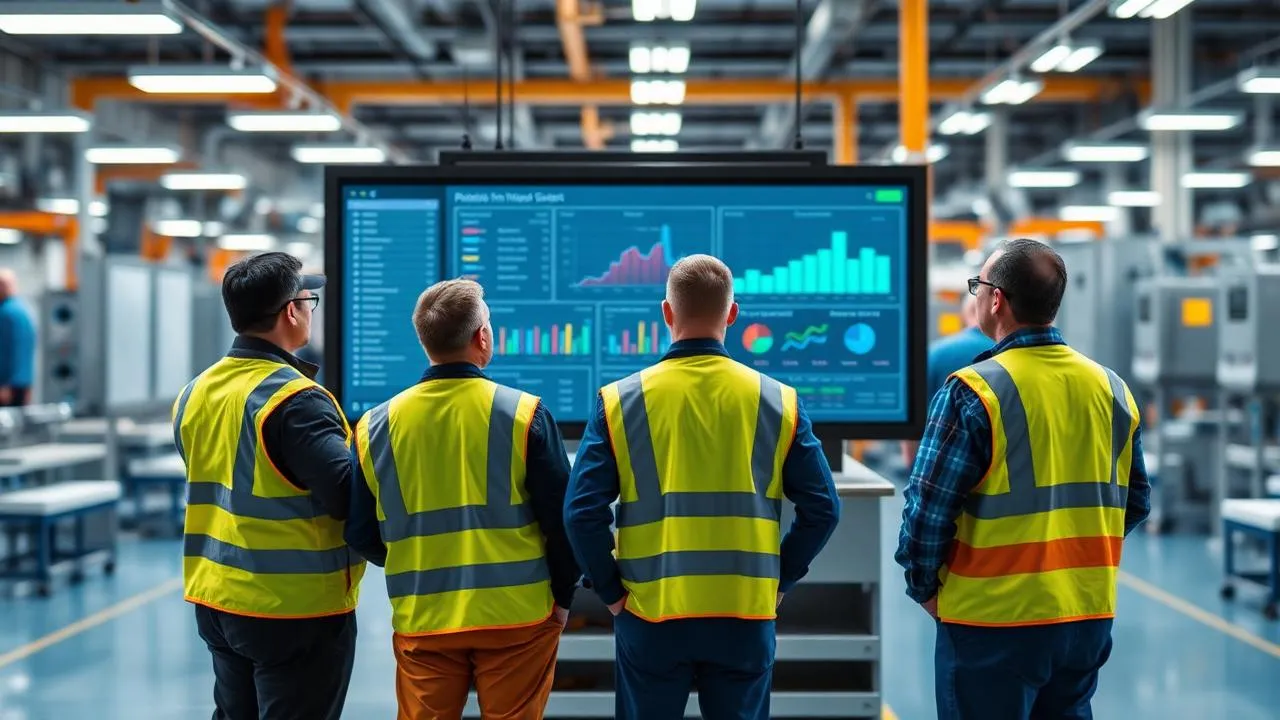

Ask any plant manager what their lead time is, and you'll get a confident answer in days. Ask them what fraction of that lead time is genuinely value-added — meaning the customer would pay for it if they saw the meter — and you'll get a much more uncertain one. The honest answer, in nearly every manufacturing operation we've ever mapped, is somewhere between two and ten percent. The other 90 to 98 percent is queues, transport, inspection, rework, batching, signature loops, and waiting. Customers don't pay for any of it. The plant absorbs the cost of all of it.
Value stream mapping (VSM) is the Lean Six Sigma tool that proves this and makes it actionable. It's the single most powerful diagnostic instrument in the methodology, and it's also the most underused — partly because it looks deceptively simple ("draw a flowchart with sticky notes"), and partly because most attempts at it never produce the second map: the future state. A VSM that ends with a current state map is a wall decoration. A VSM that produces a future state map, a 12-month implementation plan, and a finance-signed savings estimate is a strategic capital plan. This article is about how to do the second one.
We'll cover what a manufacturing VSM actually is and how it differs from a process map, when it's the right tool (and when it isn't), the data you need to gather before the workshop, how to facilitate the current state and future state, the metrics that make the analysis credible, and how to translate the future state into a sequenced 12-month roadmap that operations can actually execute. By the end you'll have a clear view of whether VSM is the right next move for your plant — and what a serious effort looks like.
What value stream mapping really is
A value stream is the complete sequence of activities — from raw material to finished product in the customer's hands — that creates value for an end customer. A value stream map is a one-page picture of that sequence, drawn at the level of the process steps (typically eight to fifteen, not eighty to a hundred), with the material flow on the bottom, the information flow on the top, the cycle time and changeover time and uptime under each process box, and the inventory between processes drawn as triangles with the days of stock noted underneath.
The crucial output of the map isn't the picture; it's the timeline at the bottom. The timeline has two values for every step: the value-added time (the actual touch time the product sees in that process step) and the lead time (the elapsed time from when the product enters that step's queue to when it leaves the next one). When you sum the two across the entire map, you get the value-added ratio: total value-added time divided by total lead time. In a typical, unimproved manufacturing value stream, this ratio is between 0.5 percent and 5 percent. We've seen it as low as 0.1 percent in highly fragmented job shops with complex routings. The exercise of seeing the number on the wall — "customers pay for two minutes; we hold the inventory for fourteen days" — is what makes the map a strategic instrument rather than a documentation exercise.
VSM differs from a process map in a critical way: a process map shows what happens; a value stream map shows where time goes. Process maps are excellent for designing standard work and for training new operators. Value stream maps are excellent for finding capital-free capacity and for setting an improvement strategy. They are not interchangeable, and a plant that has lots of process maps but no value stream map almost always has a tactical improvement program with no strategic direction.
When VSM is the right tool — and when it isn't
VSM earns its keep when the problem is end-to-end and cross-functional. If the issue is that one machine has a quality problem, you don't need a VSM — you need a root cause analysis (a fishbone, a 5-Whys, a designed experiment). If the issue is that one work cell is running slow, you don't need a VSM — you need a takt time analysis and a line balance. VSM is the right tool when the issue is that lead time is too long, inventory is too high, customers are waiting, and nobody can quite point to where the problem lives because the problem doesn't live in any single step — it lives in the spaces between steps.
These are exactly the conditions in most discrete manufacturing operations. The CFO is asking why finished-goods inventory is at 38 days when the plan says 22. The VP of sales is asking why the standard quoted lead time is six weeks when competitors are at four. The plant manager is asking why every cell is running at 78 percent OEE but the throughput at the end of the line still misses the schedule three days a week. None of these problems are visible at the cell level. All of them are visible on a value stream map.
The right product family to map
The most important up-front decision is which value stream to map. The right answer is almost never "all of our products." Pick one product family — a group of products that follow essentially the same routing through the plant. The classic test: if two products share at least 80 percent of their process steps, they're in the same family. Most plants have between three and eight families. Pick the one that's strategically most important — typically the highest-volume family on the bottleneck line, or the family that's driving the longest customer lead times — and map it first. The other families can be mapped later, and the patterns repeat.
Preparing for the workshop: the data you actually need
A value stream mapping workshop typically runs three to five days. Most of the failure modes happen in the two weeks before the workshop, when the data either gets gathered well or gets gathered carelessly. The map can only be as honest as the underlying numbers, and a map built on guesswork tells the team what they already think rather than what's actually true.
For each process step on the proposed map, you need: cycle time (the time it takes one unit to move through the step, from when work starts on the unit to when it's ready to leave); changeover time (from last good piece to first good piece on the next product); uptime percentage (the equipment's actual availability, not the nameplate); first-pass yield (the percentage of units that complete the step without rework); operator count and shift pattern; and any equipment-imposed batch size constraints. For each inventory location between steps, you need the average days of inventory and the variability (the swing between minimum and maximum). For the order entry and scheduling process, you need the elapsed time from order receipt to schedule release. For the shipping and customer side, you need the on-time delivery rate and the standard quoted lead time.
Most of this data exists in the ERP and the production logs. The piece that's almost always missing is the queue time between steps — the time a unit spends sitting in inventory waiting to be worked on. Without queue time, the value-added ratio is invisible, and the entire point of the map collapses. The fix is straightforward: pick a sample of 30 to 50 units (a serial number sample is best) and walk them through the plant with a notebook, recording the time they spend at each location. It takes a junior engineer two to three days. It is the single most valuable two days of data collection you will ever do.
Facilitating the current state map
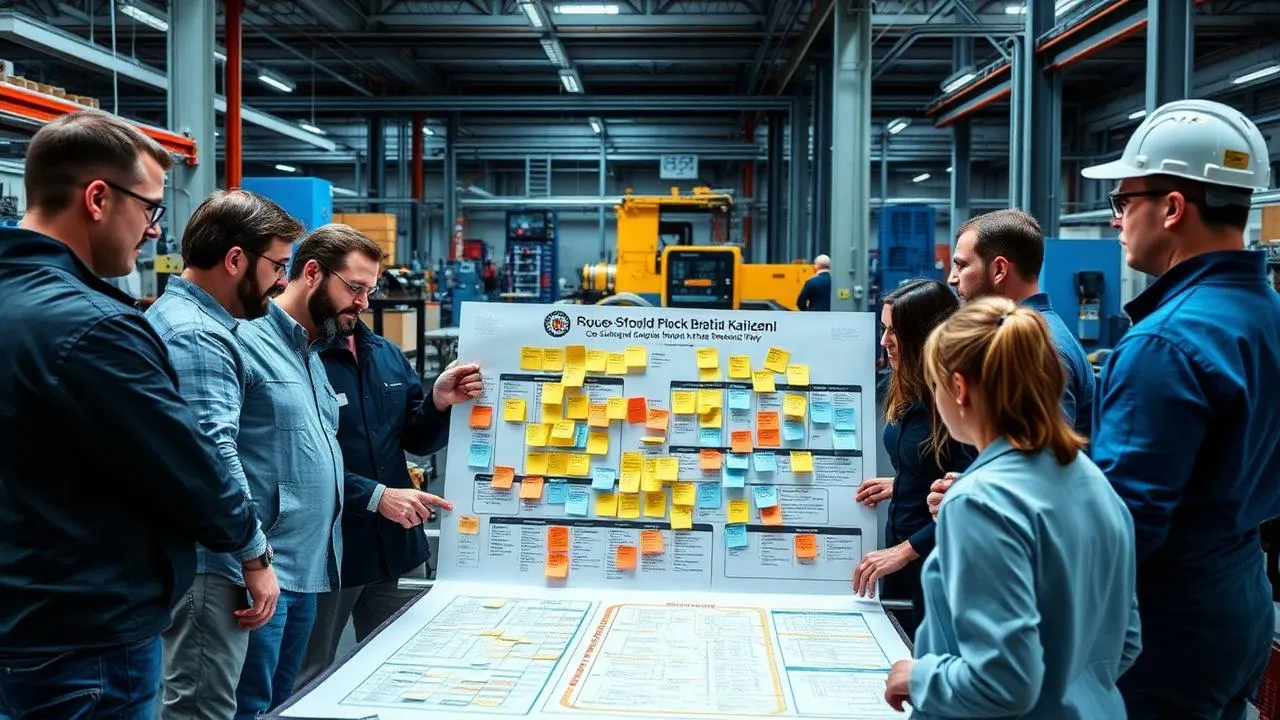
The current state map gets drawn on Day 1 of the workshop, on a wall covered with butcher paper, by the cross-functional team that actually runs the value stream. The team should include: the plant manager or operations director (sponsor, not facilitator), the production planner, the production supervisor, the maintenance lead, the quality lead, the materials manager, and an operator from each major step on the proposed map. A facilitator with VSM experience runs the workshop. If the plant has a credentialed Black Belt, that person is usually the facilitator. If not, this is a good place to bring in outside help for the first map; subsequent ones can be done internally.
The current state gets drawn process step by process step, left to right, with the team confirming the cycle time, changeover, uptime, and first-pass yield for each step against the data gathered before the workshop. The information flow gets drawn at the top — how does the order arrive, who schedules it, when does the schedule get released to the floor, how do operators know what to run next. The material flow gets drawn at the bottom, with inventory triangles between steps showing days of stock. The timeline at the very bottom captures value-added time and lead time for each segment.
When the current state is finished — typically by end of Day 1 or mid-Day 2 — the team stands back and reads the value-added ratio out loud. The number is almost always shocking, even to the people who run the value stream every day. "We have nineteen days of total lead time, and the customer is paying for forty-eight minutes." That number, on the wall, in front of the team, is what makes the rest of the workshop possible. Until everyone has internalized it, the future state will be timid. After everyone has internalized it, the future state gets ambitious.
The seven Lean wastes, in plant context
Once the current state is on the wall, the team walks the map step by step and tags every instance of waste using the seven Lean wastes (or eight, if you include the underutilization of human potential — we usually do). In a manufacturing value stream, the wastes look like this:
- Overproduction — making units before the next process needs them, which forces inventory into the queue and pushes lead time out. This is usually the biggest single waste in batch manufacturing.
- Waiting — units sitting in queue between steps. This is almost always 90+ percent of total lead time.
- Transport — moving material between steps that could be co-located. Plants laid out by department instead of by value stream are full of this.
- Over-processing — performing inspections, sign-offs, or steps that don't change what the customer values. The redundant first-piece inspection at the end of a stable process is a classic example.
- Inventory — raw, WIP, and finished-goods stock sitting between steps. Inventory hides every other waste, and reducing it is what surfaces the underlying problems that need to be solved.
- Motion — operators walking, reaching, twisting, and searching. Within a single workstation, this is usually fixable with 5S and standard work; across a plant, it's usually fixable with layout changes.
- Defects — units that fail first-pass yield and require rework or scrap. The cost of a defect grows with how late in the value stream it's detected.
- Underutilized human potential — operators with knowledge of the process whose suggestions never get implemented because the plant has no mechanism for capturing or testing their ideas. This is the waste that produces all the others over time.
Designing the future state
The future state is what makes the workshop strategically valuable. It's a redesign of the value stream that targets a 50 to 70 percent reduction in lead time, a 30 to 60 percent reduction in inventory, and a 20 to 40 percent improvement in first-pass yield, achieved over 12 to 18 months of focused improvement work. The design uses a small set of well-established Lean principles, applied to the specific value stream:
- Establish takt time. Calculate the rate at which the customer demands product (available production time divided by customer demand) and set every process step to run at or below that rate. Steps running faster than takt are over-producing; steps running slower are creating constraints.
- Build to takt with continuous flow where possible. Where adjacent steps have similar cycle times and similar batch requirements, link them into a one-piece flow cell with no buffer between. This eliminates the inventory between those steps and exposes any imbalance immediately.
- Use supermarkets and pull where flow isn't possible. Where steps can't be linked (different cycle times, shared equipment, batching constraints), use a controlled supermarket with a kanban pull signal between them. The downstream step pulls from the supermarket; the upstream step replenishes only what was pulled. This caps inventory at a known level and prevents over-production.
- Schedule from the pacemaker. Identify one process — usually the most flexible one with the shortest changeover — as the pacemaker. The plant schedule is released only to the pacemaker. Every other step runs based on the pull signal from downstream. This eliminates the dozen scheduling decisions per shift that currently drive most of the chaos.
- Level the schedule. Mix the schedule at the pacemaker to even out variation in customer demand. A plant that produces 100 units of A on Monday and 100 units of B on Tuesday creates inventory swings; a plant that produces 25 units of A then 25 units of B four times a day produces the same volume with much less inventory and much smoother flow.
- Improve the constraints. Once the flow is in place, the bottleneck step becomes obvious. Improvement effort focuses there: SMED on its changeover, OEE on its uptime, root cause analysis on its yield losses.
- Standardize and audit. Every change in the future state gets standard work, and every standard work has an audit cadence. Without the audit, the value stream drifts back to its old shape within a year.
When the future state is finished, the team draws the new timeline. In a typical first-cut future state for a manufacturing value stream, lead time drops by 50 to 70 percent, inventory drops by 40 to 60 percent, and the value-added ratio rises from 1 to 3 percent into the 8 to 15 percent range. These are not theoretical numbers; they are what plants actually achieve when they execute the future state with discipline.
Translating the future state into a 12-month plan
The future state is a destination, not a project plan. The final day of the workshop translates it into a sequenced roadmap of 8 to 15 specific projects, each scoped as a Green Belt or Black Belt DMAIC project, each with a sponsor, an owner, a baseline, a target, a timeline, and a financial estimate. Typical projects include: SMED on the bottleneck changeover, layout redesign to co-locate steps 4 and 5, supermarket and kanban installation between steps 6 and 7, scheduling redesign with the pacemaker logic, OEE improvement on the bottleneck cell, first-pass yield project on the highest-defect step, inventory reduction in raw materials.
The roadmap is sequenced by financial leverage and by dependency. Projects that unlock other projects come first. Projects with the largest dollar impact come early. Projects that require capital are scheduled to align with the capital planning cycle. The full plan is presented to the plant leadership team and to finance the week after the workshop, with a credible 12-month savings estimate. Plants that execute the roadmap with a Green Belt project leader on each project, supported by a Black Belt or external Master Black Belt for the harder analyses, routinely deliver $4 to $15 million per year in finance-validated savings on a single value stream — and a 50 percent or greater reduction in lead time on that family.
How VSM goes wrong
Most failed VSM efforts share one of three failure modes, all of which are predictable and avoidable.
The map gets drawn but the future state never gets built
This is the most common failure: the workshop produces a beautiful current state map that goes on a wall, gets photographed for a corporate communication, and never produces a second map. Without the future state and the roadmap, the current state is documentation, not strategy. The fix is structural: never schedule a current state workshop without scheduling the future state workshop on the same calendar invite, and never end the workshop without a roadmap and a sponsor commitment to fund it.
The data is wrong, so the math is wrong
If cycle times are pulled from the work standards rather than measured, if uptime is pulled from the nameplate rather than the production logs, if queue time is estimated rather than walked, the value-added ratio comes out misleading and the future state targets are unrealistic. The fix is to invest the two weeks of data collection before the workshop. It is the cheapest insurance you can buy on the engagement.
The roadmap stalls because no Green Belts exist to run the projects
A 10-project roadmap requires 10 trained project leaders. Plants that come out of a VSM workshop with no Green Belts on staff find that the roadmap sits on a shelf for nine months while they figure out who's going to run it. The fix is to align the VSM with a Green Belt cohort: certify 8 to 12 project leaders concurrently with the VSM, and assign each of them to one of the roadmap projects as their certification project. The training pays for itself two or three times over in the first cohort, and it creates a permanent improvement engine on the floor.
The strategic case for VSM in 2026
Manufacturing in the United States is in an unusual moment. Reshoring continues — Deloitte's 2024 manufacturing outlook documented a multi-year increase in U.S. capital investment in domestic capacity. Labor markets remain tight, with manufacturing job openings well above pre-pandemic levels. Capital costs are higher than they were five years ago. The combination means that capacity has to come from existing assets, run more efficiently, with the workforce that's already in place. That is exactly the problem Lean Six Sigma — and value stream mapping in particular — was built to solve. The plants that figure it out have an advantage that compounds. The plants that don't will quietly lose share to the ones that do.
If you're considering a value stream mapping engagement, or if you have a current state map sitting on a wall that never produced the future state, that's exactly what our free consultation is for. We'll walk through your current value stream, talk through the data you have and what's missing, and give you a candid view of what a credible four-month VSM-and-roadmap effort would look like in your plant. You'll leave with a sized prize and a clear next step, whether or not you decide to engage further.