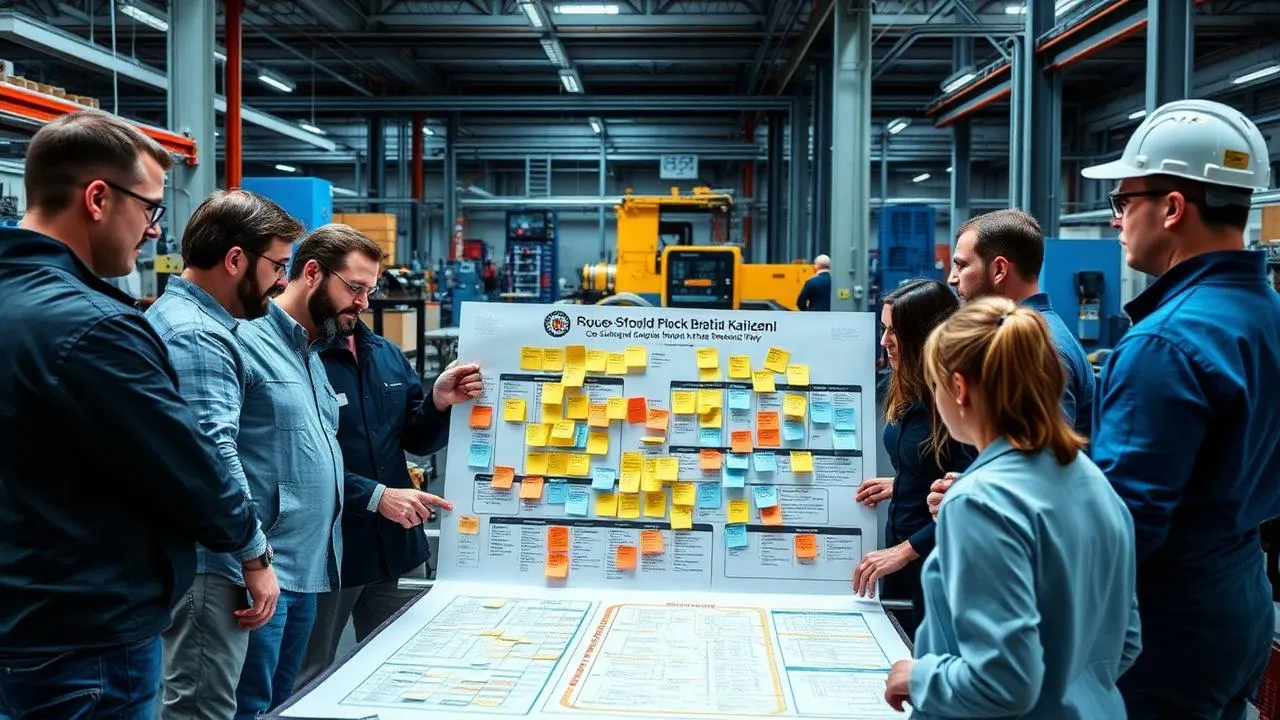


Kaizen — the Japanese word for 'change for the better' — has become one of the most overused and misused terms in process improvement. It gets attached to everything from a yearly all-hands suggestion box to a five-day focused improvement event. That's a problem, because the version that actually moves the needle is very specific, and it deserves to be called out from the noise.
When we talk about a Kaizen event in this article, we mean the focused, time-boxed, cross-functional improvement workshop. It's typically three to five days, all in the same room — physical or virtual — with one process, one goal, and the right people empowered to make decisions. By Friday, the process is meaningfully different and the new way of working is documented. That's a Kaizen event. Anything else is a different tool.
Run well, a Kaizen event is one of the highest-leverage improvement tools in the Lean Six Sigma portfolio. Run poorly — or run on the wrong problem — it's expensive theater that burns trust and produces a stack of sticky notes. This article is about how to know which one you're walking into.
What a Kaizen event actually is
A Kaizen event has six characteristics that distinguish it from other improvement work. If your event is missing any of them, what you're running probably isn't a Kaizen event — it's a workshop, a brainstorm, a meeting, or a project. Those are all useful tools too, but they have different rules and produce different results.
- Focused on a single, well-defined process — not 'our whole operation' or 'customer experience generally'
- Time-boxed — typically three to five consecutive days, with a clear start and end
- Cross-functional — the people who actually run the process, plus the people who interface with it, all in the same room
- Decision-empowered — the team has explicit authority to make changes during the event, not just recommend them
- Outcome-anchored — a measurable target on a specific metric, agreed before the event starts
- Sustainment-focused — the event ends with a control plan, standard work, and a 30/60/90 audit schedule, not just a list of ideas
Notice what's not in that list. There's no specific tool. Some events lean heavily on value stream mapping. Others are mostly waste-walking and standard work. Others are SMED-driven changeover events. The toolset flexes to the problem. The structural elements — focused, time-boxed, cross-functional, empowered, outcome-anchored, sustainment-focused — do not.
When to run a Kaizen event
Kaizen events earn their keep in a specific zone of problems. Outside that zone, other tools work better. Here are the conditions where a Kaizen event is genuinely the right call.
1. The problem is bounded and concrete
A Kaizen event needs a process you can put your hands on. Changeover on Line 7. Order intake to credit approval in claims. The customer activation flow from contract signature to first product use. Deploy pipeline from PR merge to production rollout. The reason this matters is that a five-day event needs a process you can map on Monday morning and have measurably improved by Friday afternoon. Vague problems — 'improve customer experience,' 'fix culture,' 'modernize operations' — cannot be solved in five days, and a Kaizen event will burn the team out trying.
2. The cause is genuinely unknown
Kaizen works when the team needs structured time and shared focus to discover where the problem actually lives. If you already know what the fix is and the only obstacle is execution, you don't need a Kaizen event — you need a project plan and a sponsor who'll clear the way. Reserving a five-day cross-functional event to install a known solution is overkill, and the team will quickly figure out that they were brought in for theater.
3. The problem touches multiple functions
If the bottleneck is contained inside a single team, that team can usually fix it with a focused day or two of their own work. Where Kaizen earns its premium is when the process spans handoffs — sales to operations, claims to underwriting, engineering to QA, marketing to ops, planning to production, support to product. Those handoffs are exactly where the waste hides, and getting all the relevant functions in the same room for a contiguous block of time is what makes the diagnosis and the fix possible.
4. There's a measurable target on a real metric
A Kaizen event without a target metric becomes a brainstorming session that produces interesting ideas. A Kaizen event with a target metric becomes a focused engineering effort that produces a measurable result. The difference is enormous. Before the event, the sponsor and the team agree on the metric ('reduce changeover time on Line 7 from 4.5 hours to under 90 minutes') and the target. The week is then spent working backward from that target, not forward from a list of ideas.
5. The decision-makers are willing to be in the room
This is the underrated condition. A Kaizen event needs to be empowered — the team has to be able to make changes during the week, not just propose them. That means the people with authority over the process, the budget, and the staffing have to be available. Sometimes that's the plant manager checking in twice a day. Sometimes that's a director joining for the daily debrief. Whatever the level, someone with real authority has to be on the hook for the decisions the team is going to surface. Without that, the event becomes a recommendation factory and the recommendations die in committee.
6. There's appetite to sustain the gain
The week of the event is, paradoxically, the easy part. The hard part is the 90 days after, when the new standard work is being held against business pressure and the temptation to drift back to the old way is constant. Before you commit to a Kaizen event, get an explicit commitment from the process owner that they will run the 30/60/90 audits and respond to the control plan. If that commitment isn't real, run a less expensive intervention until the appetite is there.
When NOT to run a Kaizen event
Equal time. Here are the situations where running a Kaizen event will actively make things worse — or where a different tool will produce a better result for less cost.
When the data doesn't exist
A Kaizen event runs on data. The team needs to know the baseline performance, the variation in that performance, and ideally some early signal on where the problem concentrates. If you have none of that, the first two days of the event will be spent collecting data — which is a waste of the cross-functional time that justified the event in the first place. Better to run a one-week measurement effort first and then run the event with the data in hand.
When the problem is design, not process
If the only way to fix the problem is to redesign the product, the system, or the underlying technology, that's not a Kaizen event — that's an engineering project. Kaizen tools assume you're working with the existing process and improving how it runs. If the work is to invent a new process, the methodology is DMADV (Design for Six Sigma) or a structured design sprint, not a Kaizen event.
When the team has no slack
A Kaizen event takes the participants away from their day jobs for a contiguous block of time. If the operation is so stretched that pulling those people creates a worse problem than the one you're solving, the math doesn't work. Either the event needs to be deferred until the operation is stable enough to free the people, or the process owner needs to commit explicit coverage for the participants during the event. Doing it on top of the day job — 'we'll just check in during meals' — kills the focus that makes the event work.
When the leadership team isn't aligned
If the directors and VPs over the process can't agree on what the priorities are, a Kaizen event will surface that disagreement on Wednesday and the team will spend Thursday and Friday refereeing leadership instead of fixing the process. Run a leadership alignment session first. Get the air cover sorted. Then run the event.
When the answer is genuinely capital, not process
Sometimes the honest answer is that the equipment is at end-of-life, or the system genuinely needs to be replaced, or the headcount is genuinely short. A Kaizen event will find the process improvements available in the current state — and there are almost always more than people expect — but it will not invent capacity that physically doesn't exist. If the diagnostic work clearly points to a capital decision, make the capital decision. Then run a Kaizen event to make sure the new equipment is actually used well.
What a great Kaizen event looks like, day by day
Here's the rhythm of a five-day Kaizen event run with rigor. The shape varies a bit by problem, but this is a useful default to start from.
Pre-event (two weeks out)
The sponsor and the facilitator scope the event. The target metric is set. The team is named. Pre-work data is collected. The process is observed and a draft current-state map is started. The space is booked. Coverage for the participants is arranged. The kickoff invitation goes out with the charter, the metric, and the expected outcomes attached.
Day 1: ground truth
The team gets into the same room. The sponsor opens with the charter and the target. The team builds the current-state map together — usually with a process walk in the morning to ground the map in what actually happens. By end of day, the map is on the wall, the data is on the wall, and the team has a shared picture of the current state.
Day 2: find the cause
The team uses Pareto, Fishbone, and 5 Whys against the current-state map and the data. By end of day, the team has a short list of verified causes — supported by data, not opinion — and the candidate solution space is starting to take shape.
Day 3: design the fix
The team designs the future-state process, generates and selects solutions tied to the verified causes, and starts mistake-proofing wherever possible. Pieces of the fix that are simple enough to implement during the event begin to be implemented in real time. The end of day is a daily debrief with the sponsor, including the early signals from anything piloted that afternoon.
Day 4: pilot and adjust
The redesigned process runs in real conditions — on the floor, in the system, in the queue. The team watches what happens, captures the data, and adjusts. By end of day, the team has either confirmed the fix or identified what else needs to be changed, with one more day to do it.
Day 5: lock it in
The team writes the standard work for the new process. The control plan is built — what gets monitored, by whom, on what cadence, with what response triggers. The visual management is designed and started. The 30/60/90 audit schedule is committed to. The sponsor accepts the handoff. The team does a closeout that includes the measured improvement against the original target.
30/60/90 sustainment
At 30, 60, and 90 days, the facilitator and the process owner audit the gain. Is the standard work being followed? Is the control plan running? Is the metric holding? Where is drift starting? The audit is the unsexy work that keeps Friday's gain from quietly becoming next quarter's regression.
Real-world examples
Specialty contract manufacturer — changeover
Changeover on a critical line was averaging 4.5 hours and killing on-time delivery. A five-day Kaizen event with operators, maintenance, and engineering got the standard changeover to 52 minutes by Friday. New standard work and visual controls held the gain past 90 days. Capacity unlocked on the line was equivalent to about 11 percent more production days a year — without any capital spend.
Fintech platform — release pipeline
A fintech platform team needed four to six hours to ship a release. Manual approvals, flaky tests, and config drift made every Friday a fire drill. Five days with engineering, SRE, security, and QA in the same room mapped the deploy pipeline, killed handoffs, and automated three approval gates. Standard deploy time fell to 38 minutes by Friday. Rollback events dropped to zero in the first 30 days post-event. The same Kaizen mechanics that work on a manufacturing cell rebuilt a deploy pipeline end-to-end.
Distribution center — receiving to put-away
A distribution center had a chronic receiving-to-put-away dwell time of about six hours per pallet, with overtime climbing every month. A four-day Kaizen with the receiving team, put-away team, and inventory leads cut average dwell to under 45 minutes by event close. The hidden cost was even more interesting: aisle congestion fell because product wasn't sitting on the dock, and order pick rates improved as a downstream effect nobody had expected.
Common Kaizen failure modes
Kaizen events fail in predictable ways. Recognize the pattern, fix it, run a better event next time.
The week without a target
The team produces interesting maps, generates a long list of ideas, and ends the week with a slide deck of recommendations. Nothing changes. Fix: agree the target metric and the threshold for success before the event starts.
The team without authority
The team designs an excellent fix that requires three approvals nobody in the room can give. The fix gets handed off and dies in committee. Fix: include the decision-makers, or get explicit pre-event approval that the team can act inside a defined budget and scope.
The week without sustainment
The week ends in a celebration, the standard work goes into a binder, and 60 days later the metric is back where it started. Fix: build the control plan and the 30/60/90 audit schedule into the close of the event, with the process owner explicitly committing.
The event that should have been a project
The problem is too big to fix in a week. The team gets to Friday with half the future state designed and no sustainment plan. Fix: rescope to a problem that can finish in five days, or run a longer DMAIC project with multiple Kaizen-style sprints inside it.
The event that should have been a meeting
The fix was already known. The week was spent installing it under the banner of 'Kaizen.' The team noticed and disengaged. Fix: don't run a Kaizen event when the answer is already clear. Run a focused implementation with the right project plan instead.
How Kaizen relates to other tools
Kaizen sits inside a larger Lean Six Sigma toolkit. It's not a replacement for any of the others — it's a specific high-leverage instrument with a specific job. A few common comparisons.
Kaizen vs DMAIC project
A DMAIC project is the right tool when the problem is complex enough that it needs three to six months of structured work, including data collection, statistical analysis, piloting, and change management. A Kaizen event is the right tool when the problem can be diagnosed and fixed inside a week with the right people in the room. Many DMAIC projects include a Kaizen event during their Improve phase. The two work together; they don't compete.
Kaizen vs continuous improvement
Continuous improvement is the broader practice — the daily, weekly, monthly cadence of small changes, suggestions, and adjustments that any high-functioning operation runs as standard work. Kaizen events are concentrated bursts inside that cadence, used when a process needs more focus than the daily rhythm can provide.
Kaizen vs workshops
Lean Six Sigma workshops — process mapping, waste identification, leadership alignment, root cause analysis — are training experiences that build capability and produce some artifacts. They're typically shorter than a Kaizen event and have a lower bar on outcome commitment. A workshop teaches a team how to see waste; a Kaizen event puts that team on a target metric for a week and expects measurable movement by Friday.
How to know if you're ready
If you can answer yes to the following, a Kaizen event is likely the right call.
- Can you name the specific process, end-to-end, in one sentence?
- Can you state a target metric and a numeric goal?
- Do you have baseline data on that metric — at least two months of it?
- Can you list the cross-functional team you need, by name and role?
- Will the process owner commit, in writing, to running 30/60/90 sustainment audits?
- Will a sponsor with real decision authority join the daily debrief and the closeout?
- Can the team be freed from their day jobs for the contiguous block of the event?
If you can't answer yes to all of those, the work to do first is to make those yeses real. That work is itself worth doing — and once it's done, the event is much more likely to deliver the kind of outcome that justifies the investment.
The bottom line
A Kaizen event is the right tool for a bounded, cross-functional process problem with a measurable target, real authority in the room, and an appetite to sustain the change. It is the wrong tool for an open-ended cultural initiative, a known-fix execution problem, or a design challenge that requires reinvention rather than improvement.
When the conditions are right, a Kaizen event is one of the most powerful improvement tools in the Lean Six Sigma portfolio. When they aren't, a different tool will produce a better result for less cost. The discipline is in knowing the difference — and being honest enough about your situation to use the right one.
If you're considering a Kaizen event and want a second opinion on whether it's the right move, that's exactly what a free consultation with us is for. We'll talk through the problem, the readiness, and the alternatives, and we'll give you a straight answer about whether a Kaizen event is the best use of your team's week — or whether something else will get you there faster.