

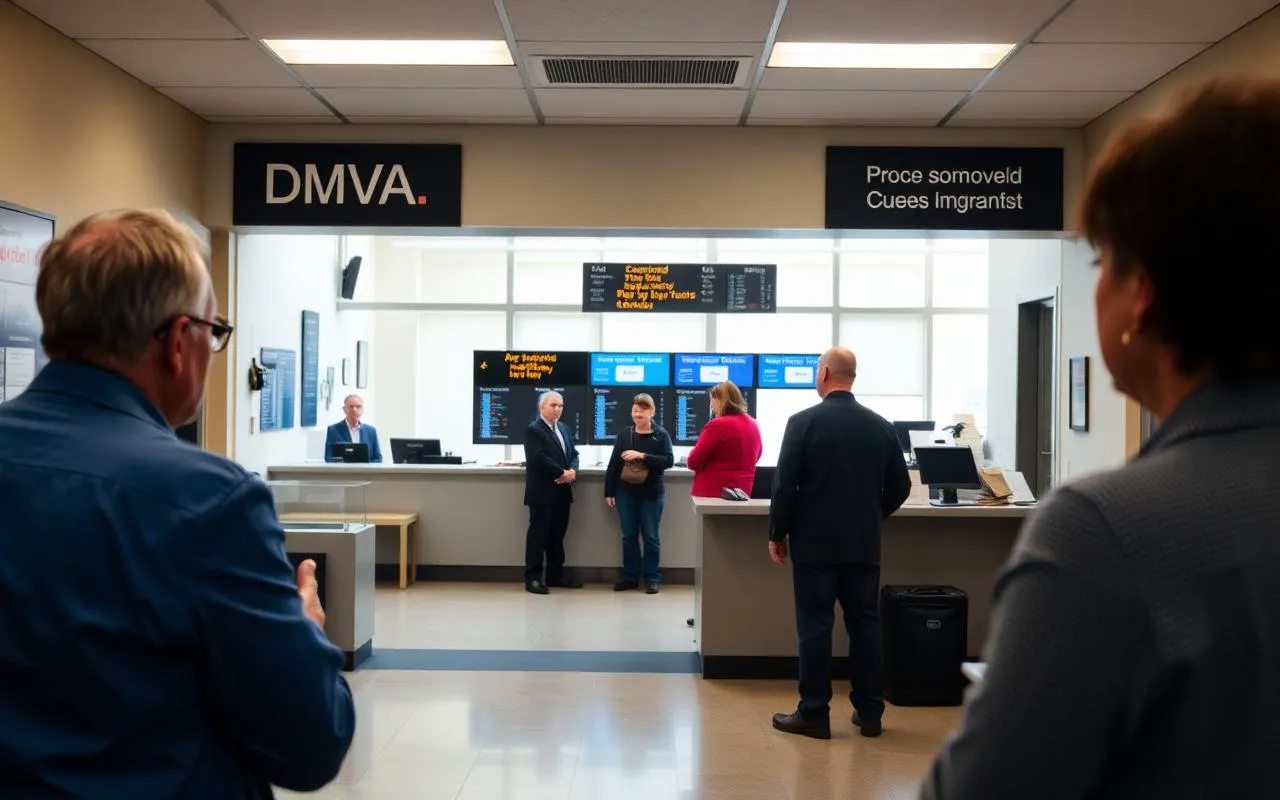
Walk into any state DMV office at 10:00 a.m. on a Tuesday and you'll see the same picture in city after city across North America. The lobby is at 130 percent of seated capacity. The digital queue display says the current wait for a registration renewal is 71 minutes; for a license-related transaction it's 94. About a third of the people in line are walk-ins who couldn't get an appointment for the next six weeks. The counter staff are working as fast as they can — and the line keeps getting longer because every fifth transaction turns into a 25-minute deep-dive after the customer's documents are wrong, their appointment was for the wrong transaction type, or the registration system can't process their out-of-state title until a supervisor overrides a flag. The local TV station is parked outside doing a 'long DMV lines' segment for the third month in a row.
DMV and motor vehicles operations are one of the highest-leverage, most politically visible places in any state government to apply Lean Six Sigma. The methodology works because a DMV office is a queueing system in its purest form — discrete transaction types, measurable cycle times, hard demand variation, and a constituent base that experiences every minute of the wait directly and tells everyone they know about it. Get it right and you simultaneously cut average wait time by 60 to 80 percent, eliminate the appointment backlog, lift CSAT by 25 to 40 points, recover counter-staff capacity equivalent to 12 to 18 percent of the workforce, and shift the public narrative around the agency in a single legislative cycle — without building new offices, without buying new queue-management software, and without expanding headcount. The published case studies from AAMVA, state operational-excellence offices in Indiana, Tennessee, Georgia, Virginia, and the Australian state transport agencies consistently document these results.
This article is the playbook. We'll walk through what DMV wait times actually cost in constituent time, political capital, and operational waste, how to size the prize, the structured DMAIC approach that delivers durable wait-time reduction (and why a new appointment system alone rarely does), the workforce dynamics that decide whether the gain holds, and the mistakes that quietly destroy the math.
Why DMV wait time is the most undervalued metric in state government
Most state motor vehicles agencies track three numbers: average wait time across all transaction types, appointment availability (days until next available slot), and constituent satisfaction. The benchmarks are well-published by AAMVA. Top-quartile state DMV operations run an average wait of 9 to 14 minutes, appointment availability inside 5 business days, and CSAT of 78 to 86. The U.S. median runs 38 to 64 minutes wait, 18 to 35 days appointment lead, and CSAT of 41 to 58. The gap between top-quartile and median is roughly the ROI of a structured Lean Six Sigma program — and the political dividend is substantial.
Here's the math that gets a governor's attention. A typical state DMV operation handles 4 to 8 million in-person transactions per year across 30 to 80 offices. At a median 51-minute average wait, that's 3.4 to 6.8 million constituent-hours of wait time consumed annually. Independent valuations of constituent time used by state operational-excellence offices typically value that hour at $20 to $35 (a conservative blend of median wage and opportunity cost). On a mid-size state, that's $80 to $240 million of constituent time consumed by the wait every year — almost all of it avoidable. Beyond the constituent-time math, every state DMV is carrying real internal cost: overtime to keep offices open late, supervisor escalations on stuck transactions, security incidents driven by frustrated customers, and the political cost of being the most-complained-about agency in state government.
The internal capacity recovery is just as real. A typical DMV office spends 22 to 30 percent of counter-staff time on rework — restarting transactions because the customer brought wrong documents, supervisor overrides on system flags, no-show appointments that disrupted the schedule, and walk-in surge management on days when appointment availability collapsed. Driving first-touch transaction completion from 78 to 95 percent recovers 12 to 18 percent of the counter-staff workforce. On a 1,200-counter-staff state agency, that's 140 to 220 FTEs of capacity that come back to the team — without new hires, and without changing a single statute.
The methodology: DMAIC for the DMV office
DMAIC works in DMV operations the same way it works in manufacturing — same five phases, same tollgate discipline. The difference is that DMV variability is dominated by demand pulse (every license expires, every registration renews, on a calendar schedule the customer doesn't choose), transaction-type complexity (a single office handles 80+ distinct transactions, each with its own documentation and system path), federal Real ID requirements, and a unionized civil-service workforce. The methodology has to account for that. Projects that try to redesign the counter without first solving demand smoothing and transaction routing produce a fast initial gain that decays at the next license-renewal peak. Projects that combine demand strategy, transaction routing, channel migration, and counter-process redesign in a sequenced DMAIC structure produce 60 to 80 percent wait-time reductions that hold across calendar pulses and Real ID surges.
Define: scope the office cluster and transaction mix
The first mistake most DMV agencies make is trying to fix all 60 offices simultaneously with a single statewide rollout. Don't. Pick a cluster of three to six offices that span urban, suburban, and rural settings, pick the top five to seven transaction types by volume, and pilot the redesign there. Define the scope as 'wait time and first-touch completion rate for [transaction types] across the [cluster] offices.' Statewide single-shot rollouts produce nothing the control plan can hold and nothing the next governor will defend.
The Define charter names the office cluster, the transaction types, the baseline (average wait, 90th-percentile wait, appointment availability, first-touch completion rate, CSAT), the target (typically 60 to 80 percent wait-time reduction, appointment availability inside 5 days, CSAT lift of 25+ points), the dollar value (calculated against constituent-time recovered, counter-staff capacity, and overtime reduction), the timeline (120 to 180 days for the cluster pilot), and the sponsor (typically the deputy commissioner or chief operations officer).
Measure: timestamp the constituent journey
This is the step most agencies skip. The queue-management system tells you wait time and transaction time. It does not tell you the full constituent journey. To genuinely understand the gap, the Measure team has to spend two to three full days in each pilot office, timestamping every step: arrival to check-in, check-in to seat, seat to call-up, call-up to transaction start, transaction time, supervisor-override time, system wait time, document-discovery time (the moment the customer realizes they're missing a document), restart time, and exit. Build the timestamped breakdown across 200 to 400 constituent journeys per office.
What you find is almost always the same shape. Active counter-staff transaction time runs 14 to 22 percent of total elapsed time in the office. The remaining 78 to 86 percent is queue, system wait, document-discovery wait, and rework. The 'we need more counter staff' conversation that dominates every legislative session is solving the wrong problem. The real lever is the queue, the document-discovery cycle, and the no-show / walk-in surge dynamic — all addressable without new hires.
Analyze: find the rework and demand-smoothing levers
Analyze is where the money gets identified. Three questions matter. First: what are the top reasons transactions go into a rework or supervisor-escalation cycle, and what percent of transactions are affected by each? In every DMV we've worked with, three to five issues account for 70 to 80 percent of all transaction failures — usually a mix of wrong documents, Real ID confusion, out-of-state title verification, registration fee disputes, and proof-of-residency issues. Once you have the Pareto, the upstream fix is structural: a pre-arrival document checklist sent at appointment confirmation, a SMS-based document-readiness check 24 hours before appointment, and clearer signage in the office collapse the rework rate by 50 to 70 percent.
Second: what is the demand pulse, and where can it be smoothed? Pull the transaction volume data hour-by-hour across a full year. Almost every DMV has Tuesday and Saturday peaks at 130 to 160 percent of average, and Wednesday/Thursday troughs at 60 to 75 percent. Smoothing demand by 20 percent through differential appointment availability, off-peak text-message reminders to customers eligible for renewal, and dynamic walk-in pricing or wait-time signaling can collapse peak waits by 35 to 50 percent without adding any capacity.
Third: what percent of in-person transactions could be completed online or by mail? In every state we've analyzed, between 18 and 35 percent of in-person transactions are renewals, address changes, or duplicate-document requests that have been available online for years but the customer didn't know it. A targeted SMS or email campaign that tells eligible customers 'you can complete this online in 4 minutes' typically migrates 35 to 55 percent of those transactions out of the office within 90 days — collapsing in-office demand without changing service.
Improve: redesign the front door, the counter, and the channels
The Improve phase has four concrete interventions that produce most of the gain. First: a pre-arrival document and transaction-type validation. Customers who check in via SMS or kiosk get a 90-second confirmation of which documents they're bringing and which transaction they need. Customers missing documents get diverted to a 'come back when you have X' track that doesn't consume counter time. This single intervention drops first-attempt failure from 22 to under 5 percent. Second: transaction-type routing. Stop running a single counter line for all transactions. Route quick transactions (renewal, address change, replacement) to a fast-lane counter; route complex transactions (out-of-state title, commercial license, name changes) to specialist counters with longer slot times. Top-quartile DMV agencies run three to five distinct counter tracks. Third: channel migration. Run a sustained SMS and email campaign telling eligible customers to use online and mail channels, and track the migration rate weekly. Fourth: a daily 15-minute office-level stand-up where the supervisor reviews wait time, queue depth, no-show rate, and rework drivers from the previous day. The stand-up is the single most reliable habit in sustaining the gain.
None of these interventions require replacing the queue-management system. All of them can be piloted in 60 to 120 days. The discipline is in resisting the urge to launch a $30 to $80 million queue-management or DMV-system replacement as the answer — which, in most states, will deliver the same broken process on a new screen.
Control: lock the gain into office routine
Control is where most government Lean projects fail. Sustaining requires three things. First, written standard work for every step in the redesigned process — short, picture-heavy, single-page documents at every counter. Second, a daily visual management board in every office showing wait time, queue depth, no-show rate, and the rework Pareto from the previous day. Third, a monthly metrics review with the regional manager and a quarterly review with the commissioner that compares offices against each other and identifies the next round of improvement.
The political and workforce dynamics that decide the project
DMV Lean Six Sigma projects fail more often for political and workforce reasons than for technical ones. Three dynamics deserve direct attention before the team is chartered.
The unionized counter workforce wants the project to succeed
The counter staff and their union representatives have lived the broken process longer than anyone. They know exactly which transactions cause supervisor escalations, which system flags fire on the wrong cases, and which times of day produce the rudest customers. The mistake leaders make is hiring an outside firm to redesign the counter and announcing the new way of working. The right approach is to charter a cross-functional Green Belt project where two or three of the most respected counter staff, a supervisor, and a union representative are core team members. The redesign becomes theirs.
The legislature needs a wait-time dashboard, public, monthly
The fastest way to lose political support for a DMV project is to brief the legislature on 'process improvement' without a wait-time number that improves on a visible cadence. Pick one metric — average wait time across the pilot cluster, posted on the agency website with a monthly trend chart — and report it publicly from launch onward. When the number moves from 51 minutes to 32 to 19 to 11 over six months, the project becomes politically untouchable and the next phase of expansion writes itself.
Real ID and federal-rule changes will keep coming — design for it
Federal-rule changes (Real ID, commercial licensing, voter-registration integration) will continue to land on every state DMV. The Lean Six Sigma redesign has to assume that. Build a process that can absorb a new transaction type or documentation requirement in 30 days through a standard-work update — not a system change. Top-quartile DMV operations have an internal change-control discipline that lets them roll out a new federally-required documentation step across all offices in 14 to 21 days. Median operations take 6 to 12 months and produce a wait-time spike every time.
Three field examples (composite, drawn from real engagements)
Mid-size state, license renewal cluster
A mid-size state DMV cluster of five offices was running an average wait of 58 minutes, an appointment backlog of 31 days, and a CSAT of 47. A 150-day Green Belt project, sponsored by the deputy commissioner and led by a senior office manager with two counter staff, the union steward, and the IT analyst on the team, mapped the constituent journey across all five offices. The Pareto on rework showed that four issues — wrong documents at appointment, Real ID confusion, out-of-state title gaps, and proof-of-residency issues — accounted for 76 percent of rework. SMS-based pre-arrival document validation, transaction-type counter routing, and an aggressive online-renewal migration campaign drove average wait to 14 minutes within 120 days, eliminated the appointment backlog inside 4 months, and lifted CSAT to 79.
State agency, statewide rollout after pilot
Following a successful 5-office pilot, a state DMV expanded the redesign to all 47 offices over 18 months using a structured rollout protocol: 6 offices per quarter, with the previous quarter's offices providing peer coaching to the next group. Average statewide wait dropped from 51 to 13 minutes, the agency moved from worst-in-state CSAT to top-quartile, and the legislature redirected a planned $42 million queue-management system replacement to other modernization priorities.
Large urban state, channel migration
A large urban state ran a focused 90-day project on channel migration alone, sending targeted SMS and email outreach to customers with online-eligible transactions. 41 percent of targeted customers completed the transaction online within 30 days of the message. In-office demand dropped 19 percent statewide, walk-in waits dropped 38 percent without any in-office process change, and the agency was able to close two underutilized offices without service degradation, recovering $4.3 million in annual lease and operating cost.
What it costs and what it returns
A coached Green Belt DMV cluster project — one Green Belt, a small cross-functional team, a Master Black Belt providing two days a month of coaching — typically runs 120 to 180 days and costs $40,000 to $90,000 in external coaching plus the internal time of the team. The recovered counter-staff capacity and overtime reduction usually pays back inside the first six months. The constituent-time recovery and political dividend are larger and harder to monetize directly but easy to defend with a public wait-time chart. Across a full statewide rollout, most states see average wait reductions of 60 to 80 percent, appointment-backlog elimination, CSAT lifts of 25 to 40 points, and operational savings of $8 to $25 million annually depending on size.
The mistakes that destroy the math
Three mistakes account for most failed DMV Lean Six Sigma projects, and all three are avoidable.
First: replacing process redesign with technology replacement. A new queue-management system or DMV platform layered onto a broken process is the most expensive way to fail. The federal landscape is full of $30 to $150 million state DMV system implementations that produced no wait-time improvement. Sequence the work — redesign first, automate second.
Second: skipping the union and the counter workforce. Bringing in an outside firm to redesign the counter and handing it to staff for execution produces predictable, organized resistance. The redesign team must include the people who will execute the new process.
Third: dropping the public wait-time dashboard. The single most reliable predictor of sustained gain is whether the wait-time number is posted publicly every month for at least eighteen months after rollout. When the number stops being public, the gain decays inside two staff transition cycles.
How to start
If you're a DMV commissioner, deputy commissioner, or operations director reading this and wondering whether a Lean Six Sigma project is the right next step, the practical first move is small. Pick a cluster of three to five offices where wait times and political pressure are loudest. Ask your team to pull the wait-time, no-show, and rework data for the last 30 days. Look at the Pareto. If three to five rework drivers account for more than half of all transaction failures, you have a project worth chartering — and the financial, political, and constituent cases will write themselves.
If you'd like a second opinion on whether a DMV wait-time project is the right move for your agency, that's exactly what a free consultation with us is for. We'll talk through the offices, the workforce conditions, and the readiness — and we'll give you a straight answer about whether a chartered Green Belt project is the right next step or whether a different intervention will get you there faster.